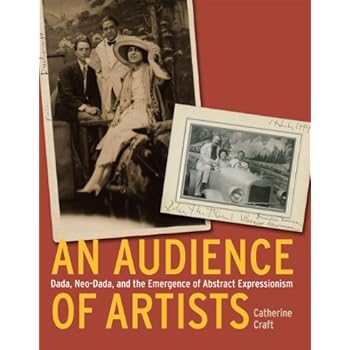
An Audience of Artists: Dada, Neo-Dada, and the Emergence of Abstract Expressionism
Category: Books,Arts & Photography,History & Criticism
An Audience of Artists: Dada, Neo-Dada, and the Emergence of Abstract Expressionism Details
Review “With characteristic elegance, Craft recasts Abstract Expressionism’s development in terms of the avant-garde movements which preceded and followed it. An Audience of Artists adds considerable nuance to our understanding of the history of American art at midcentury and greatly refines our understanding of the claims and stakes implicit in the development of an American avant-garde and modern art in general.”—Anne Goodyear, National Portrait Gallery (Anne Goodyear)“An Audience of Artists goes a long way toward finally clarifying the networks of contacts both within specific avant-garde circles in America and among them. It helps us understand what Duchamp thought of the painters who came to fame toward the end of his career—and how his reactions to these artists clarified his own artistic identity. Finally, this book fills a gap in the scholarship by placing Abstract Expressionism in relationship to the postwar strategies of Dada, rather than in terms of Surrealism and the unconscious. Craft’s study of Motherwell’s Dada anthology is especially enlightening as a microcosm of all varieties of interchange.” (Janine Mileaf, Swarthmore College)“An Audience of Artists is elegantly written and deeply pondered, with an analytical sophistication and emotional sensitivity that gets under the skin of cultural history and the forces that change art. Catherine Craft knows how history feels. She presents documentation with an interpretive skill that causes a reader to sense past events as if they were just occurring. Craft’s visual description is no less convincingly vivid. It is exciting to read this innovative study. I found myself rereading it, not only for edification but for the intellectual pleasure of it.” (Richard Shiff, University of Texas at Austin) “This well-written, engaging book . . . [focuses] on the circumstances and relationships that fostered [neo-Dada’s] development.” (Choice) “Craft makes the rather compelling argument that through its reception of Dada, the New York School was able to map its own position within a previously populated modernist terrain. . . . Such a claim offers a valuable counter to the narratives of American modernism as holed up in the privacy of its own thoughts and reproductive of post-war narratives of American hegemony and individualism.” (Art History)“[Craft’s] performance is engagingly instructive and, at its most compelling moments, full of compassionate insight.” (Art in America) Read more About the Author Catherine A. Craft is an independent scholar, curator, and lecturer specializing in modern and contemporary art. She is adjunct assistant curator for research and exhibitions at the Nasher Sculpture Center in Dallas, Texas, and the author of Jasper Johns and Robert Rauschenberg. Read more


Reviews
This is a superb read. In her Preface Catherine Kraft mentions that the book travelled with her for nearly a decade. This quality of prolonged reflection illuminates her text: the author has seen, felt, thought & understood what was 'contemporary' to the aesthetic & historical moment.For 'the happy few' who would rather hang out in the working studio than the commercial galleries, auction rooms [sadly], or museum these essays into the artist's personal conception of their time, space, & role is a delicious voyage.The book is physically a delight; buy a ticket & enjoy.A central satisfaction of Craft's writing -to be held & savoured- is that we as viewers may participate in the paralyzing calculation & fraught concerns of the artists. Her close reading allows us to fantasize as co-conspirators in our studio visits to Motherwell, Pollock, & Barnett Newman. The insistent references to the artist's texts are more than respectful, allowing for a sense of dialogue & reconsideration. Delusion certainly, but Craft has grasped the driving need of the aesthete to connect. Furthermore, she suggests that the New York Abstract Expressionist artists in the early 1940's found themselves in a remarkably similar position to ourselves, being an isolated community of Viewers of their own work.There is a promise of a second volume on the Neo-Dadaists of the later 1950's.My copy is already on pre-order.